


Why Germany Loves Techno: The Culture, Clubs and History

Why Germany Loves Techno
Berlin is the capital. But why? A FERAL insider read on post-Wall spaces, church organs, and the country that turned a 4/4 kick into a national identity.
The Short Answer
- Techno was invented in Detroit. Germany adopted it, scaled it, and never let go.
- The Berlin Wall fell in 1989. Two months earlier, acid house landed. The timing was divine.
- Tresor opened in a bank vault. Berghain in a power station. The buildings wrote the sound.
- Germans treat club music the way they treat organ music — spiritual, serious, uninterrupted.
- The all-black minimal aesthetic you wear to raves everywhere was coded in Berlin. You're already German, you just don't know it.
Ask anyone in the scene where techno lives and you get the same answer. Berlin. Every time. Not Detroit, where it was born. Not Chicago, where house ran parallel. Not Amsterdam, not London, not Barcelona. Berlin.
That answer is so reflexive we rarely question it. But it's one of the strangest cultural migrations of the last fifty years — an American genre, invented by three Black producers in a collapsing industrial city, adopted by a reunifying European capital and turned into a state religion. How did that happen? And why Germany, specifically?
We've spent years on German dance floors. Watched the sun come up on the Sisyphos terrace. Queued three hours for Berghain and got turned away. Queued four and got in. Played warehouses in Leipzig, clubs in Frankfurt, afters in Neukölln. This is what we actually think is going on.
The Wall Came Down. The Spaces Came Empty.
You cannot tell the story of German techno without starting on 9 November 1989. The Berlin Wall fell, East and West were suddenly one city, and half the map emptied overnight. Factories shut. Power stations switched off. Entire blocks of Mitte and Friedrichshain sat unlocked, unowned, and completely unpoliced while the bureaucracy worked out who held the deeds.
That gap — call it two or three years of legal vacuum — is the single most important thing that ever happened to dance music. In most cities, a warehouse party ends when the police arrive. In 1990s Berlin, there were no police because there was no paperwork to say who owned the warehouse. Permission was granted by default. The city went feral.
Into that vacuum walked a generation of young Germans — East and West mixed together for the first time — looking for a soundtrack that didn't belong to either side of the old border. Rock was the West. Protest songs were the East. Techno was neither. It was American, it was electronic, it had no lyrics and no leader, and nobody's parents understood it. Perfect.
Tresor, 1991
Dimitri Hegemann found the old underground vault of the Wertheim department store — bombed out in the war, abandoned through the GDR years, rusted steel safety deposit boxes still bolted to the walls. He put a soundsystem in it. Tresor opened March 1991. Detroit producers flew over. Jeff Mills, Juan Atkins, Blake Baxter. The Berlin–Detroit axis that still defines techno was welded together in a literal bank vault. You could touch the original vault doors on the dancefloor. Most of the ravers who were there will tell you they never heard music that loud again.
E-Werk opened in 1993 inside a decommissioned power substation. Der Bunker took over a Nazi-era air-raid shelter. Ostgut — the direct ancestor of Berghain — ran out of a converted freight depot. The sound of German techno isn't just what came out of the speakers. It's what the walls did with it. Concrete, steel, ceilings high enough for a hymn.
Music as Ritual: The German Cultural Code
Here's a theory the tourist articles never get to. Germany has a specific, centuries-old relationship to music as a serious, collective, spiritual experience — and techno fits into that lineage more cleanly than it fits anywhere else.
Bach wrote for the organ. Wagner wrote for the opera house. The Romantic tradition treated instrumental music as something you sat still for, took seriously, let wash over you for hours. No lyrics required. No narrative required. The sound itself was the point. This is a country where you are culturally permitted — encouraged, even — to stand in a dark room and listen to a single harmonic idea develop for forty-five minutes.
Drop a 140bpm kick drum into that cultural frame and you don't get "party music". You get modern sacred music. The club is the church. The DJ is the organist. The dance floor is the congregation. Nobody's talking. Nobody's performing. You're there to be inside the sound.
- Club closes at 3am, 4am max
- Bottle service and VIP tables
- DJ as personality, crowd as audience
- Phones out, story in progress
- Dress to be seen
- Music as backdrop to socialising
- Open Friday night until Monday morning
- No tables, no bottles, one line for everyone
- DJ as celebrant, crowd as participants
- Phones taped, cameras banned
- Dress to disappear into the room
- Music as the reason you're there
This is why a Berghain set is forty-eight hours long. It's why Klubnacht at Tresor genuinely runs from Friday night to Sunday evening. It's why Kater Blau has three dance floors, a boat, and a set of bunk beds. You're not going out. You're going in — and you're not expected back for a while.
The Berlin Institutions — Why Each One Matters
Every city has clubs. Berlin has institutions that have been running, essentially unchanged in ethos, for two decades and counting. The short list most people outside Germany have heard of:
Berghain
A decommissioned combined heat-and-power plant in Friedrichshain, converted 2004. The Panorama Bar upstairs, the Säule side-room, the main floor with the 12-metre ceiling and the Funktion-One wall that makes your chest cavity hum. The door policy is legendary because it has to be — the Berghain ethos dies the moment it becomes a queue of bachelor parties. Sven Marquardt, the tattooed bouncer, has kept the room honest for twenty years. Phones get stickered at the door. What happens inside stays inside. That's not marketing. That's the contract.
Tresor
The original. Moved out of the bank vault in 2005, reopened in a decommissioned power station on Köpenicker Straße in 2007. Still running the Detroit–Berlin axis harder than any other club on earth. The Globus floor upstairs runs house and techno. The Tresor floor downstairs — the "Säule" tunnel, dripping water, strobes, no bass cut — is still one of the most physically intense rooms in dance music. If you want to understand where modern hard techno came from, you go there.
Sisyphos
Lichtenberg, east of the city. An abandoned dog biscuit factory (yes, really) that became the spiritual home of Berlin's outdoor summer rave culture. Multiple stages across a sprawling complex — the Hammahalle, the Wintergarten, the lakeside beach area. It's warmer, friendlier, hippier than Berghain. Less gatekept. Sets run Friday night straight through Monday morning. If you've ever seen photos of people dancing in a lake at sunrise with disco balls in the trees, that's Sisyphos.
Kater Blau
On the Spree river at Holzmarkt, directly next door to the Bar 25 wreckage that gave birth to it. The original Bar 25 was the hedonistic Burning Man of Berlin from 2004-2010. When it shut, the crew built Kater Blau on the same spot — three dance floors, boat parties, a restaurant, the most lovingly maintained riverfront party real estate in Europe. Deeper, funkier, more melodic than the techno monasteries. Worth the trip for Sunday afternoon alone.
KitKat
The fetish institution. Running since 1994, survived every wave of scene change, still the most sexually liberated room in any major European city. Techno soundtracking a dress-code that you either respect or don't enter. We wrote a full scene guide — read the KitKat dress code guide here — but in short: latex, leather, skin, and serious music. It exists only in Germany. It could only exist in Germany.
It's Not Just Berlin — The Rest of the Map
Reducing German techno to Berlin is like reducing British music to London. It's where the journalists live, but the country is bigger than the capital.
Leipzig
The most underrated city in European techno. Institut für Zukunft (IfZ) — "Institute for the Future" — is a cooperative club in the Plagwitz industrial district that runs some of the most uncompromising hard techno bookings in Germany. No photos. No corporate sponsorship. Collective ownership. The entire eastern-German warehouse-rave scene treats Leipzig as its home base, and the sound coming out of it — harder, faster, more industrial than Berlin's current direction — is what you now hear at every European festival.
Frankfurt
The other end of the German techno story. While Berlin was figuring out post-Wall freedom, Frankfurt was running Sven Väth's operation — the Cocoon nights, the Omen club (closed 1998), and the Robert Johnson club just across the river in Offenbach, which is still one of the most respected rooms in the country for house and melodic techno. Frankfurt gave the world Sven Väth, Ricardo Villalobos (via Chile), and the entire "Cocoon sound" that dominates Ibiza in August. It's warmer, more melodic, more Mediterranean than Berlin. Worth the trip.
Cologne, Hamburg, Munich
Cologne has Kompakt Records — Michael Mayer's label — one of the most influential minimal-house imprints of the 2000s. Hamburg has Übel & Gefährlich, up in a WW2 flak tower in the middle of a park. Munich has Blitz Club — the acoustically obsessive, Funktion-One-calibrated room under the Deutsches Museum that books some of the most tasteful hard-techno lineups in the country. Each city has a different accent. The vocabulary is shared.
Don't fly into Berlin, queue for Berghain, and fly home. If you've got a long weekend — Friday IfZ in Leipzig, Saturday Blitz in Munich, Sunday Robert Johnson in Frankfurt — gives you a sharper cross-section of German techno than any three Berlin clubs in a row. The autobahn is your friend.
The Festival Circuit — Where the Nation Gathers
Germans take their festivals as seriously as their clubs. A few of the flagship dates on the calendar:
Time Warp — Mannheim, every April since 1994. The defining indoor techno festival on the planet. 20,000 people, one weekend, bookings that read like the history of techno condensed into 72 hours. Richie Hawtin, Sven Väth, Charlotte de Witte, Amelie Lens, and whoever's running the scene that year. Time Warp is the state of the nation address for European techno.
MELT — Ferropolis, until 2023. RIP. The "City of Iron" — an open-air museum of enormous Soviet-era coal-mining excavators — used to host MELT every July, stages built between the 30-metre machines. The festival ended in 2023 but the spirit of German outdoor raving lives on at Fusion (Lärz), Garbicz (just across the Polish border, run by Berliners), and Nation of Gondwana.
Kappa FuturFestival — Turin, Italy, but culturally German. Every major Berlin DJ plays it. It's essentially the Berlin scene on summer holiday. We've linked the full run-down in our 2026 festival guide here.
How German Techno Dressed the World
If you've ever worn all black to a club, you've dressed like a Berliner. That simple. The global techno uniform — heavyweight cotton, zero logos, one colour, practical cuts — was codified on the Berghain dance floor in the 2000s and exported everywhere. London wears it. Tbilisi wears it. Melbourne wears it. Brooklyn wears it.
The logic is functional before it's aesthetic. Bright colours look bad under red club lights. Logos make you a target for the bouncer's attention. Tight cuts restrict movement. Synthetic fabrics stink by hour four. Heavyweight cotton doesn't. Oversized cuts let you move. Black absorbs light, strobes, and sweat without betraying you. The Berliners figured this out a decade before the rest of the scene caught up.
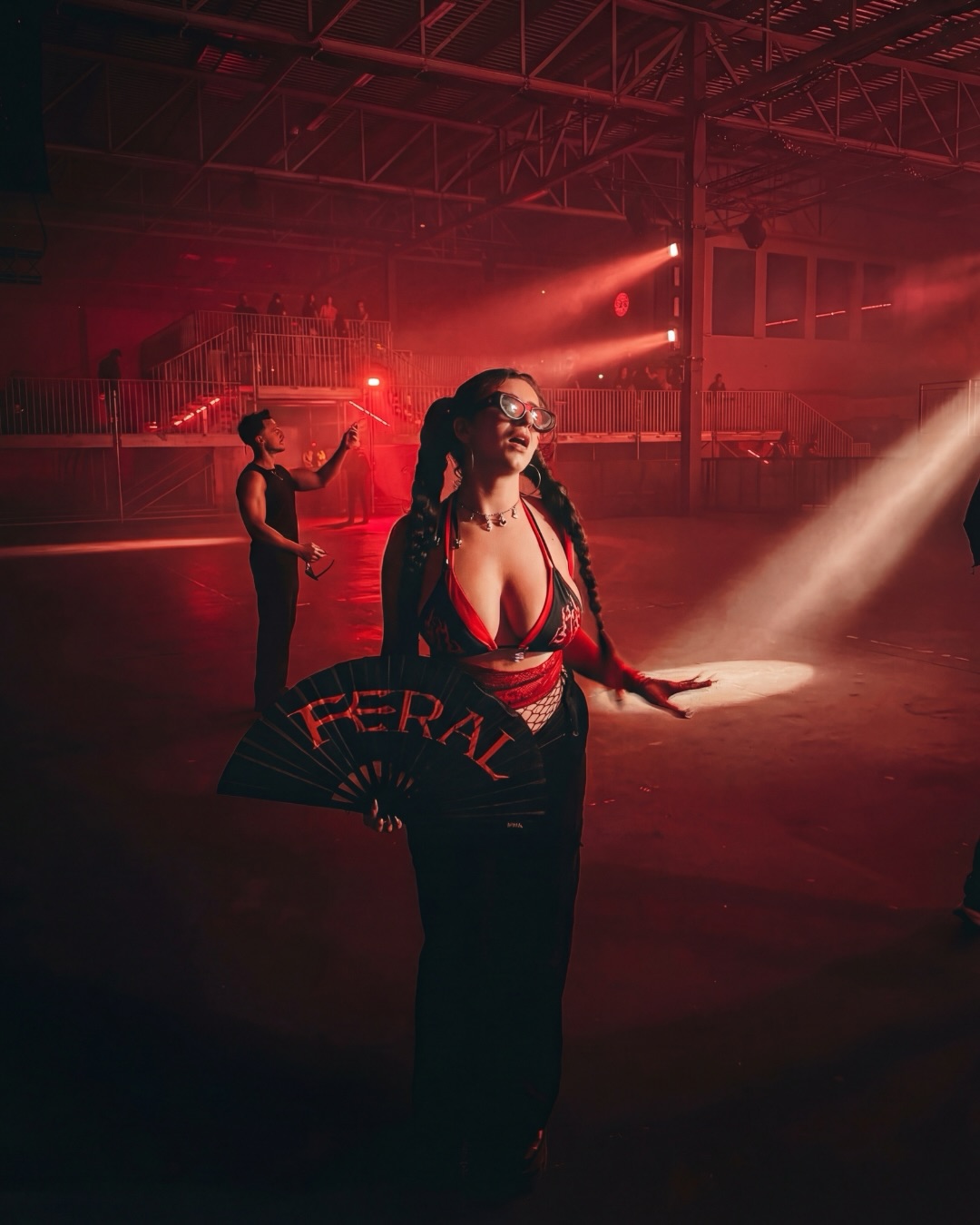
What's come next is a return of detail into the all-black uniform. Embroidered sigilism where a logo used to go. Red flash accents where colour used to be forbidden. Heavier fabric, sharper cuts, darker graphics. This is where FERAL sits — our cyber sigilism collection reads directly from the German palette. Black first. Red second. Everything else: banned.
 The Signature
Devour Red Sigil Hoodie
Shop the Hoodie →
The Collection
FERAL Sigilism
Shop Sigilism →
The Signature
Devour Red Sigil Hoodie
Shop the Hoodie →
The Collection
FERAL Sigilism
Shop Sigilism →
To understand why this aesthetic reads the way it does — why a single-colour hoodie with a hand-drawn sigil feels right in a room full of strangers — read our complete guide to cyber sigilism. The design language is older than the techno scene. The two just happened to collide in Germany.
For the musical roots of all this — how the Detroit spark actually travelled, producer by producer, city by city — our companion piece "Techno's German Roots" walks the genealogy end to end.
Doing Germany Properly — The Rules
You're going to Berlin. You've booked the flight. Here's the honest cheat sheet on how to not get filtered at the door and how to actually enjoy yourself once you're in.
- Wear black. Head to toe. No exceptions.
- Arrive after 2am for Berghain. Sober but relaxed.
- Queue quietly. Alone or in a pair, not a rowdy group of six.
- Know at least one artist on the lineup if the bouncer asks.
- Phone stickered at the door. Leave it stickered.
- Drink water. Eat something before you go in.
- Commit to the long format. Six hours minimum inside.
- Bachelor party uniforms, branded lanyards, suit jackets.
- Roll up at midnight expecting the floor to be on.
- Group of 10. Split up and meet inside.
- "Is the DJ any good?" to the person in front of you in the queue.
- Film the DJ. Film the dance floor. Film anything.
- Treat Berghain as a bucket-list tick. They can smell it.
- Leave after 90 minutes. That's not a rave, that's a photo op.
Heavyweight cotton. Cyber sigilism. Black-first palette, red accents, zero logos. Built in the UK, coded in Berlin.
Shop FERALFrequently Asked Questions
Why is Berlin considered the techno capital of the world?
Three reasons converged. One: the Wall fell in 1989 and left huge swathes of East Berlin abandoned and un-policed, giving the early techno scene free rent and permission to build. Two: German culture treats long-form instrumental music as serious, even sacred, which fit techno's structure perfectly. Three: the first wave of producers — Tresor, Hard Wax, Ostgut/Berghain — built institutions that have run continuously for two-plus decades. Other cities had great moments. Berlin had continuity.
Did Germans invent techno?
No — techno was invented in Detroit in the mid-1980s by Juan Atkins, Derrick May and Kevin Saunderson (the "Belleville Three"). But it arrived in Germany at exactly the moment the country was reunifying, and Germany scaled it, institutionalised it, and kept it alive when Detroit's own scene faded. The Detroit–Berlin axis has been the core of techno's international identity since Tresor opened in 1991.
Why do Berlin clubs stay open so long?
German cities have no legal closing time for licensed venues — the "Sperrstunde" was effectively abolished for Berlin in 1949 and in a few other Länder afterwards. Combine that with a culture that treats a dance floor as a long-form experience rather than a quick night out, and you get Klubnacht: Friday night to Monday morning. The club doesn't close. People leave when they're done.
What's the deal with the Berghain door policy?
The door isn't random — it protects the room. Sven Marquardt and his team are looking for people who will add to the dance floor, not spectate on it. That means respecting the dress code (black, practical, no logos), arriving at the right time (late, and sober enough to stand), knowing why you're there, and not treating the club as a tourist stop. It's strict because the alternative is the room becoming a theme park, which has happened to every famous club that didn't gatekeep.
Is techno only big in Berlin, or across all of Germany?
All of Germany. Leipzig has IfZ and a scorching eastern warehouse scene. Frankfurt has Robert Johnson, Sven Väth's Cocoon, and a long house/techno heritage. Munich has Blitz, acoustically one of the best rooms in Europe. Cologne has Kompakt Records. Hamburg has Übel & Gefährlich inside a WW2 flak tower. Each city has a different accent but the shared language is the same.
What should I wear to a German techno club?
Black, head to toe. Heavyweight cotton or tech fabric. Oversized cuts. Practical footwear (trainers or boots) you don't care about. No visible branding. No bachelor-party uniforms. If it's KitKat, the dress code flips into fetish territory — latex, leather, skin — and we've written a full KitKat dress code guide for that. For everywhere else: Berghain rules apply. Black first, everything else optional.
What are the biggest techno festivals in Germany?
Time Warp in Mannheim every April is the flagship — 72 hours indoor, the lineup reads like a history of techno. Fusion Festival in Lärz every summer is the legendary outdoor weekend. Nation of Gondwana, Garbicz (just over the Polish border), and until 2023 MELT at Ferropolis were the others. We cover the full 2026 circuit in our European hard techno festivals guide.
Is it true Germans don't film in clubs?
It's enforced, not just cultural. Berghain stickers both cameras on your phone at the door. Tresor, Sisyphos, Kater Blau, and IfZ all enforce a no-phones policy to varying degrees. The point is to make the room a shared present-tense space — what happens here, stays here — rather than a performance for your timeline. It's one of the main reasons the scene has stayed authentic.
How did German techno influence global fashion?
The all-black, no-logo, heavyweight-cotton, practical-cut uniform that's now the default at underground raves from London to Melbourne was codified on the Berghain dance floor in the 2000s. The logic is functional — black absorbs club light, heavy cotton survives hours of sweat, oversized cuts let you move — but the aesthetic has travelled far beyond its original use. Brands like FERAL build directly off that palette: black foundations, red accents, cyber sigilism as the signature motif.
Stay bold, stay unique, and always — stay feral.